
- All
- Product Name
- Product Keyword
- Product Model
- Product Summary
- Product Description
- Multi Field Search
Views: 0 Author: Site Editor Publish Time: 2026-07-24 Origin: Site


While steam models often dominate mainstream retail shelves, they are not the only solution. The humble electric dry iron remains a high-volume staple. It serves hospitality procurement, specific regional markets, and commercial tailoring effectively. You will find these units operating constantly in environments demanding raw reliability.
The primary sourcing risk involves balancing cost-efficiency with reliable performance. You must prevent high return rates caused by faulty internal components. A successful procurement cycle requires identifying manufacturers using highly durable soleplate coatings. You also need precise bimetallic thermostats to prevent fabric damage. Furthermore, you must secure reasonable Minimum Order Quantities (MOQs). These quantities must match your current inventory turnover rate.
This guide provides a practical framework to evaluate technical specifications. We will help you verify supplier claims effectively during the negotiation phase. You will learn how to structure your shortlisting process before committing to a massive bulk purchase. We focus on actionable testing methods to ensure product safety.
Soleplate durability dictates lifespan: Choose between a Teflon soleplate iron for cost-sensitive markets or a stainless steel soleplate iron for premium durability; verify coating thickness during the sample phase.
Thermostat accuracy prevents liability: Test sample units on varying fabric settings (silk to linen) to ensure temperature variance remains within a safe ±5°C margin.
MOQ flexibility mitigates risk: Standard factory MOQs range from 1,000 to 3,000 units. Negotiate trial runs (500 units) by accepting standard unbranded packaging before moving to custom OEM tooling.
Application dictates form factor: Weight and wattage requirements differ significantly between a standard household dry iron and a portable dry iron intended for travel or hotel use.
You might wonder why institutional buyers still source non-steam models. The answer lies in pure, uncompromised reliability. Without built-in water reservoirs, you immediately eliminate the most common failure points. There is zero calcium buildup to clog internal vents. You face absolutely no water leakage issues. Internal rusting becomes practically impossible. This directly reduces warranty claims. It also lowers your Return Merchandise Authorization (RMA) rates drastically.
Let us examine the target demographics closely. These units are highly ideal for hotel room amenities. Hotel guests rarely clean or maintain provided appliances. A waterless design requires extremely low maintenance from housekeeping staff. Specific global markets also face severe hard water issues. Hard water destroys steam chambers very quickly. Quilting and crafting consumer segments also demand heavy, dry heat. They must press seams perfectly flat without warping the fabric.
Consider the favorable cost-to-margin ratio. Lower manufacturing complexity results in significantly lower unit costs. You do not pay for internal water pumps, rubber seals, or steam valves. This allows for higher retail markups. It also improves purchasing efficiency for bulk buyers. You capture reliable profit margins while avoiding post-sale service headaches. Your customer support team spends less time handling defect complaints.
The soleplate interacts directly with delicate fabrics. Its overall durability dictates the entire product lifespan. You typically choose between two main materials during procurement.
A Teflon soleplate iron utilizes a PTFE non-stick coating applied to an aluminum base. It offers excellent glide on synthetic fabrics. Manufacturers find it highly cost-effective to produce. However, the coating remains susceptible to scratching. Zippers and metal buttons will damage it over time. Scratches create drag. This eventually ruins delicate garments. Never accept generic factory claims regarding coating quality. Demand supplier data on coating thickness. They should measure this in exact microns. Request standard adhesion testing results.
Alternatively, you might select a stainless steel soleplate iron for premium markets. It boasts extreme durability. It resists scratches effectively. Users find it much easier to maintain. It also offers a premium perceived weight. The shiny aesthetic appeals to high-end buyers. Conversely, stainless steel can stick to delicate fabrics. This happens if the thermostat malfunctions. It also carries a slightly higher baseline cost. Always check the grade of the stainless steel. Demand 304-grade steel. This prevents corrosion in humid ocean shipping environments.
You might occasionally encounter alternative coatings. Factories sometimes offer ceramic or polished aluminum variants. Ceramic provides smooth gliding but chips easily upon impact. Bare polished aluminum oxidizes over time. We consider these middle-ground options. They remain less standard in typical wholesale procurement.
Best Practice: Request sample plates coated simultaneously with the mass-production batch. Conduct an independent ASTM D3359 cross-hatch test.
Common Mistake: Accepting basic "non-stick" claims without verifying the exact PTFE formulation or curing temperature.
Material Type | Primary Advantage | Main Vulnerability | Best Target Market |
|---|---|---|---|
Teflon (PTFE) | Superior glide on synthetics | Prone to scratching over time | Budget retail, basic motels |
Stainless Steel | Extreme durability and rust resistance | Can stick at very high heat | Premium hospitality, tailoring shops |
Ceramic | Even heat retention | Chipping from physical impact | Specialty craft and sewing markets |
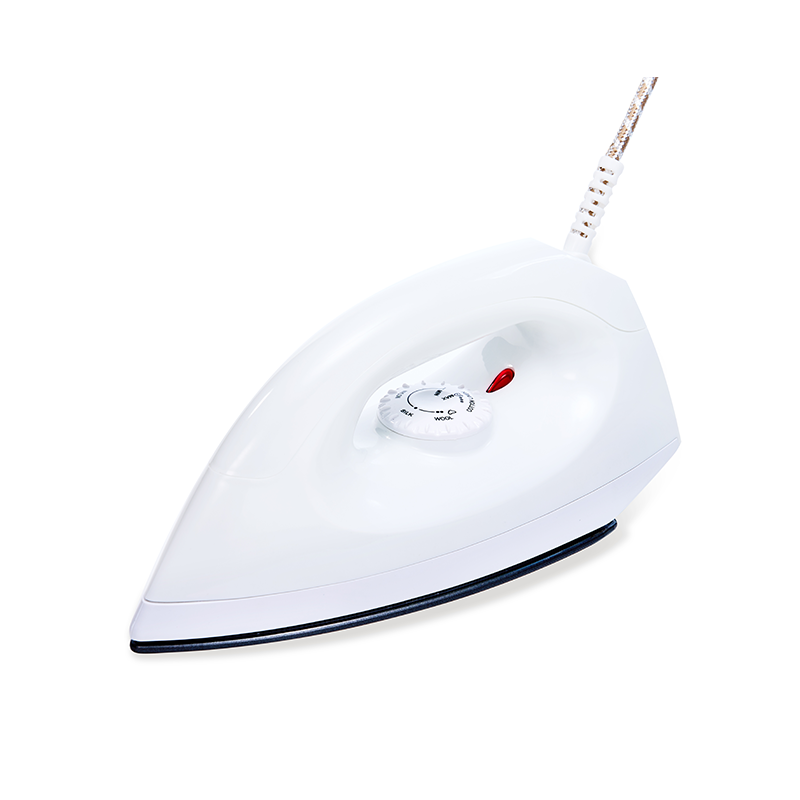
Heat management defines a reliable dry iron. You cannot compromise on these critical internal components.
The bimetallic thermostat acts as the absolute core component. It regulates power based on rapid temperature changes. You must deeply evaluate the supplier's component sourcing. Cheap thermostats fail frequently. The internal metals stick together. They lead to a dangerous phenomenon called "temperature creep." The unit gets progressively hotter than the selected dial setting. This risks severe fabric burns and massive liability. Always ask your factory to specify their thermostat component brand.
Next, analyze the critical wattage-to-weight ratio carefully. A standard unit typically ranges from 1000W to 1200W. Heavyweight models rely on physical mass. They do not need extreme heat to press heavy fabrics like cotton or linen. The cast-iron weight does the actual pressing work. Conversely, placing high wattage in a lightweight plastic chassis causes problems. It almost always leads to uneven heat distribution. The heating element overpowers the thin metal base plate.
You must conduct strict thermal mapping during your sample testing. When you receive a "golden sample," do not just plug it in. Use an infrared thermometer or a thermal imaging camera. Test the heat distribution across the entire soleplate surface.
Follow this exact thermal mapping process:
Set the dial strictly to the maximum cotton/linen setting.
Wait exactly five minutes for the heat cycle to stabilize fully.
Measure the exact temperature at the center point.
Measure the temperature at the narrow front tip.
Measure the temperature at the wide rear heel.
The tip and center should maintain incredibly consistent heat. You should find absolutely no cold zones. A variance larger than 10°C indicates poor internal heating element design.
Application heavily dictates the physical design. You must align the form factor closely with your target users. Scalability depends completely on choosing the correct chassis.
Let us examine the standard household dry iron first. These require a significantly heavier base. Factories often use cast iron internally to add necessary heft. The handle requires a well-designed ergonomic grip for prolonged daily use. A longer power cord remains essential. Look for durable cords measuring at least 1.8 meters in length. You will sell these to everyday consumers. Commercial laundry services buy them in massive bulk. Professional tailoring shops rely on them daily. The physical weight helps crease thick trousers efficiently.
Compare this directly to a portable dry iron. Factories build these specifically for travel and hospitality settings. These models feature convenient foldable handles. They utilize a very lightweight plastic chassis to save baggage weight. Dual-voltage capabilities (110V/220V) are strictly necessary here. This ensures international usability for global travelers moving across borders. Hotel chains love these compact units. Travel accessory retailers stock them heavily throughout the year.
There is a major risk factor to consider here. You must inspect the voltage selector switch carefully. Ensure dual-voltage switches are deeply recessed into the casing. If they protrude outwards, users toggle them accidentally. Plugging a 110V-set unit directly into a 220V socket causes immediate electrical blowouts. This creates a massive fire hazard. A recessed switch requires a coin or pen to turn, preventing accidental misuse.
Finding a factory online is easy. Vetting them thoroughly requires intense discipline. You must validate their operational logic and compliance records.
Navigating Minimum Order Quantities (MOQs) acts as your first hurdle. The standard factory tier usually ranges from 1,000 to 3,000 units. Factories require these numbers for custom OEM branding. They need high volume to mix custom plastic colors efficiently.
However, you should try "testing the waters" initially. Negotiate a lower MOQ for your first trial run. Request exactly 300 to 500 units. You can convince them by utilizing the factory's existing mold. Accept their standard plastic colors without changes. Use basic white-label packaging. You pay separately for a customized user manual. This strategy lets you validate market demand safely before making a major capital commitment.
Crucial compliance certifications cannot be ignored. Never import electrical appliances without verifiable, third-party lab testing. Customs authorities will seize non-compliant goods at the port.
Required certifications include:
CE and RoHS: Mandatory for entering the European market legally.
UL or ETL: Strictly required for North American liability coverage and retailer acceptance.
CB Scheme: Highly recommended for global adaptability and much easier local testing.
Always ask the factory for the original test report number. Verify it directly with the issuing laboratory online. Fake certificates circulate frequently.
Finally, enforce strict Quality Control standards. Implement an Acceptable Quality Limit (AQL) inspection before shipment. You must set strict numerical limits. Define critical defects clearly. Exposed internal wiring or complete thermostat failure equals a rejected batch. Set Critical defects at 0. Classify minor defects logically. Soleplate scratching or packaging dents might tolerate a 4.0 AQL threshold. Hire an independent third-party inspector to pull random samples before container loading.
Base your final supplier choice on more than just the lowest quoted unit price. Evaluate their willingness to provide transparent soleplate coating data. Check their thermostat component source carefully. Reward suppliers offering flexibility on initial trial MOQs. Price matters, but reliable functionality protects your brand identity in the long term.
Take these specific next steps immediately:
Request a detailed technical specification sheet (Spec Sheet) from your top three suppliers.
Demand two identical "golden samples" from each factory for benchmarking.
Conduct in-house thermal mapping tests across the entire soleplate surface.
Perform adhesion scratch testing on all coated models.
Verify all compliance lab reports online before finalizing your Purchase Order (PO).
Actionable diligence removes sourcing guesswork entirely. You secure functional, safe inventory that sells consistently.
A: Standard MOQs typically range from 1,000 to 2,000 units. Factories need this volume to offset the costs of mixing custom plastic colors and setting up silk-screen logo printing. If you want to test the market first, ask for white-label, off-the-shelf models. You can sometimes source these basic units at 500 pieces by utilizing existing factory designs.
A: Dry models are inherently leak-proof. They require absolute zero maintenance regarding calcification and hard water scaling. Furthermore, they provide the heavy, flat pressure required for specific quilting, sewing, and commercial tailoring tasks. They press seams perfectly flat without warping the fabric with unwanted moisture.
A: You should conduct an adhesion cross-hatch test using a utility knife and standardized tape. This reveals if the coating flakes off easily. Alternatively, simulate long-term wear yourself. Iron repeatedly over metal zippers or heavy buttons. Observe exactly how quickly the non-stick coating degrades or scratches under duress.
A: Yes, they are completely safe if manufactured correctly. They must carry proper UL or CE certifications verifying their electrical integrity. Crucially, they must feature a deeply recessed voltage switch. A hard-to-reach switch prevents accidental toggling by guests, eliminating the risk of electrical blowouts caused by incorrect voltage settings.


