
- All
- Product Name
- Product Keyword
- Product Model
- Product Summary
- Product Description
- Multi Field Search
Views: 0 Author: Site Editor Publish Time: 2026-10-23 Origin: Site


Water spots, stubborn calcium stains, and ruined delicate fabrics result from unpredictable iron leaks during routine garment care. Nothing frustrates users more than pressing a silk blouse only to have the iron dump a puddle of dirty water onto the fabric. This failure stems from a physical limitation in standard irons. When you lower the soleplate temperature to safely press delicate materials, the internal heat drops below the vaporization point of water. The steam chamber floods because the water cannot convert to steam. Liquid escapes directly through the soleplate vents. To solve this thermodynamic problem, appliance engineers developed specific mechanical solutions. These devices utilize an internal mechanism designed to automatically halt water flow at low temperatures. Understanding exactly how this internal valve system operates allows you to evaluate appliance reliability. You can maintain the equipment properly and protect your most sensitive garments from irreversible water damage.
Mechanical Intervention: Anti-drip systems utilize a specialized valve (often controlled by a bimetallic strip) that physically blocks water from entering the steam chamber when the iron is set to low heat.
Fabric Protection: By preventing a steam iron leaking at low temperature, these systems safely allow the ironing of delicate fabrics (silk, synthetics) that cannot withstand steam-generating heat levels.
Maintenance Dependency: The longevity of an anti-drip system is heavily dependent on scale management; calcium buildup can prop the anti-drip valve open, rendering the feature useless over time.
User Habit Synergy: Even the best anti-drip systems require proper user habits, such as avoiding overfilling the reservoir and waiting for temperature indicator lights, to function flawlessly.
Evaluation Criteria: When shortlisting models, buyers must evaluate the synergy between the anti-drip valve, soleplate material, wattage (heat recovery speed), and internal descaling mechanisms.
A functional iron must meet one strict baseline expectation. It should only deliver dry heat or vaporized steam. It must never deposit liquid water onto your garments. Establishing this baseline helps us understand the exact failure points of standard ironing equipment. You cannot properly evaluate anti-drip solutions without first understanding why traditional models fail so consistently.
Steam generation relies on basic thermodynamics. Inside the iron, water drips from the upper reservoir into a specialized vaporization chamber. This chamber sits directly above the heated soleplate. When you set the iron to high temperatures, typically above 100°C or 212°F, the incoming water hits the hot metal. It instantly flashes into steam. The resulting pressure forces this steam out through the soleplate vents. The steam penetrates the fabric to relax stubborn wrinkles. Heavy cottons and linens require this aggressive steam penetration to achieve a crisp finish. The system works perfectly as long as the soleplate maintains a temperature well above the boiling point.
Problems arise immediately when you transition to ironing delicate fabrics like silk, nylon, or polyester. These materials melt or scorch under high heat. You must turn the thermostat down. Consequently, the soleplate temperature drops well below the boiling point of water. In standard models without safety mechanisms, water continues to drip from the reservoir into the vaporization chamber. Because the chamber lacks the heat required to flash the water into vapor, the liquid simply pools inside. Eventually, gravity and internal displacement force this unheated water out through the vents. This thermodynamic failure directly causes a steam iron leaking at low temperature.
You must differentiate between true thermodynamic failures and user-induced leaks. Mechanical limitations happen automatically based on temperature physics. User errors force water out regardless of the internal temperature. Overfilling the reservoir past the designated maximum fill line creates hydraulic pressure. This pressure pushes water past internal baffles and directly into the steam channels. Storing the appliance horizontally while the tank remains full allows water to bypass the vaporization chamber entirely. These actions cause leaks that no internal valve can prevent.
The physical manifestation of this failure is obvious. You will see a steam iron dripping water from soleplate vents directly onto the ironing board. The secondary damage proves much more severe. Liquid water leaves permanent spots on delicate silk garments. It deposits concentrated white mineral stains onto dark fabrics. Soaking the fabric unintentionally prolongs your ironing time. You must wait for the material to dry before you can safely press it again.
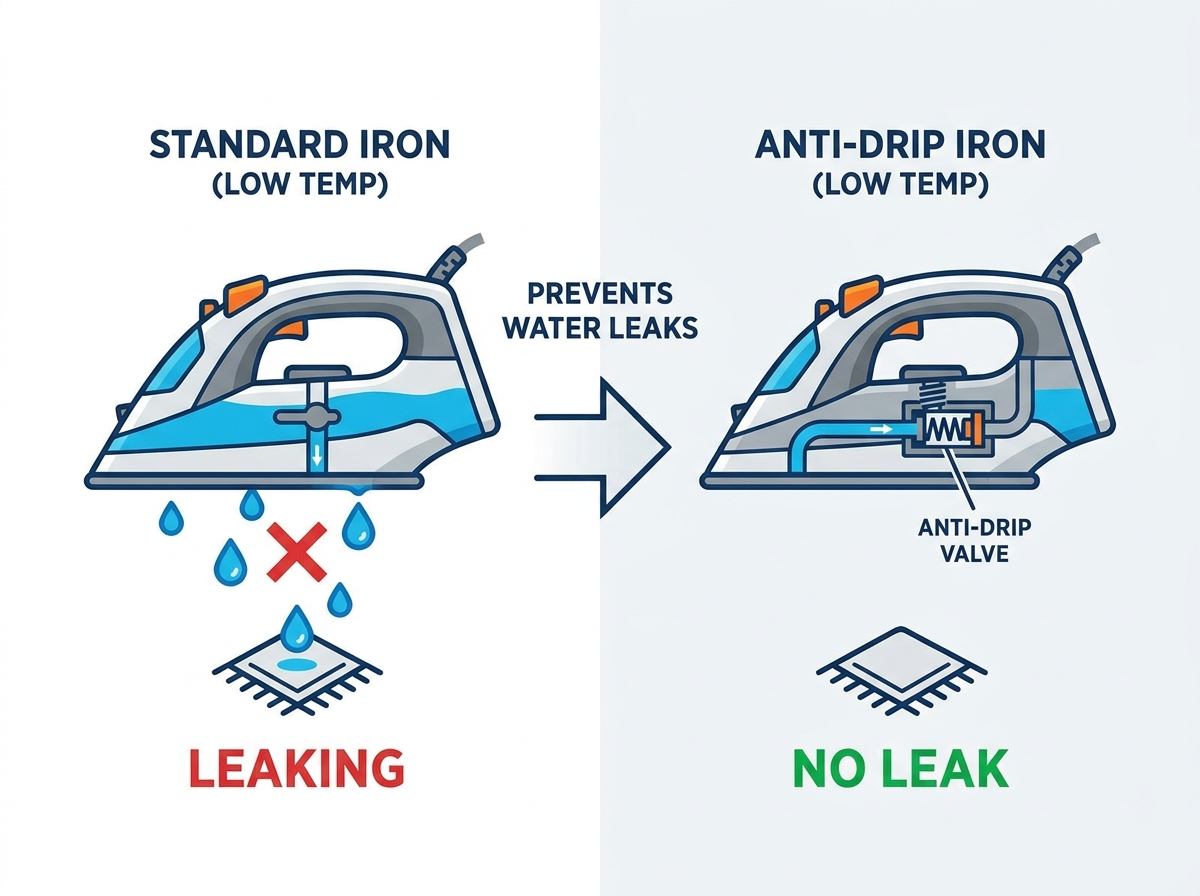
Manufacturers engineer specific internal solutions to solve the low-temperature leak problem. These solutions generally fall into mechanical and electronic categories. Both approaches aim to sever the water supply to the vaporization chamber the moment the soleplate temperature drops below the safe steam-generation threshold. Understanding how does anti drip work in steam iron designs helps you troubleshoot issues later.
The primary mechanical solution relies on a physical barrier. A standard anti-drip valve steam iron incorporates a spring-loaded mechanism positioned precisely between the water tank and the vaporization chamber. When engaged, this valve completely blocks the drip nozzle. It acts as a physical gatekeeper. It ensures no liquid can pass into the lower heating area unless the conditions are optimal for vaporization.
This mechanical valve operates using the physics of a bimetallic strip. This strip consists of two different metals bonded together. Each metal expands and contracts at a different rate when exposed to heat. The strip connects directly to the soleplate. As you lower the thermostat for delicate settings, the soleplate cools. The bimetallic strip reacts to this temperature drop by bending or contracting. This physical movement mechanically pushes the anti-drip valve closed. It cuts off the water supply automatically. It requires no manual input from the user.
The bimetallic strip provides the force, but the actual water stoppage relies on physical gaskets. The valve utilizes high-temperature silicone or rubber seals to create a watertight barrier against the drip nozzle. The quality of these specific seals determines the overall lifespan of the anti-drip feature. If the rubber degrades from constant thermal cycling, the valve will fail to seat properly. It allows water to seep through even when the bimetallic strip applies full pressure.
Premium smart irons often discard the mechanical bimetallic strip in favor of electronic sensor systems. These models utilize digital thermistors embedded in the soleplate to monitor the temperature continuously. When the thermistor detects a drop below the vaporization threshold, the internal computer triggers an electronic solenoid. This solenoid instantly snaps the water valve shut. Electronic systems offer higher precision. They suffer from far less mechanical wear over time compared to traditional spring-loaded valves.
Assessing the build quality of a modern anti-drip steam iron requires looking beyond the marketing label on the box. You must evaluate how different internal components interact with the anti-drip mechanism to produce a reliable, leak-free ironing experience.
Wattage directly impacts anti-drip performance. A higher wattage appliance, typically 1700W or above, recovers its internal temperature much faster after applying a burst of steam. Faster heat recovery means the soleplate spends less time below the vaporization threshold. Consequently, the anti-drip valve engages less frequently. This rapid recovery provides a smoother, uninterrupted ironing experience. You do not have to pause and wait for the iron to reheat between passes.
The material of the soleplate dictates how well the appliance retains heat. Better heat retention minimizes the rapid temperature fluctuations that can trigger the anti-drip mechanism unnecessarily. Different materials offer varying levels of synergy with internal valve systems.
Soleplate Material | Heat Retention Quality | Impact on Anti-Drip Mechanism |
|---|---|---|
Stainless Steel | Moderate to High | Heats up quickly but loses heat rapidly during heavy steaming. May cause the anti-drip valve to engage frequently during continuous use. |
Ceramic Coated | High | Distributes heat evenly and retains it well. Reduces unnecessary valve actuation, providing a highly consistent steam output. |
Titanium | Very High | Exceptional heat retention and rapid recovery. Keeps the vaporization chamber at optimal temperatures, minimizing anti-drip engagement. |
Internal valves cannot prevent leaks caused by hydraulic pressure from overfilling. A transparent or brightly lit water reservoir serves as your first line of defense. Clear visibility allows you to monitor the water level accurately. You can stop pouring before you breach the maximum fill line. This simple design feature perfectly complements the internal mechanical valve.
The layout of the micro-steam holes works in tandem with the anti-drip system. Properly engineered vents ensure that when the valve opens and steam generates, the vapor distributes evenly across the fabric. Poor vent design can trap steam. The trapped steam cools, condenses back into liquid water, and drips onto the garment. This mimics a valve failure even when the anti-drip system functions perfectly.
Anti-drip systems provide excellent protection, but they are not immune to failure. These internal mechanisms require specific user behaviors and regular maintenance to maintain their efficacy over years of use.
The greatest threat to any internal valve system is hard water. Tap water contains dissolved calcium and magnesium. When water flashes into steam, it leaves these minerals behind. Over time, these deposits accumulate directly on the internal components. If scale builds up on the delicate silicone seal of the anti-drip valve, the valve cannot close fully. A tiny gap remains. Water will continuously leak through this gap, completely bypassing the temperature controls.
Choosing the right water directly impacts the lifespan of the internal seals.
Water Type | Mineral Content | Impact on Anti-Drip Valve |
|---|---|---|
100% Tap Water | High (varies by region) | Accelerates scale buildup on the silicone gasket. Requires frequent descaling to prevent leaks. |
100% Distilled Water | Zero | Prevents scale but can aggressively leach metals from internal components, causing premature mechanical failure. |
50/50 Mixture | Balanced | The optimal choice. Reduces scale accumulation while preventing metal leaching, maximizing valve lifespan. |
You must actively manage mineral buildup to protect the valve. Utilize the appliance's self-clean function regularly to flush loose scale out of the steam chamber. Follow the manufacturer's specific guidelines regarding water usage. Flush the system over a sink at least once a month if you live in a hard water area.
Mechanical systems require time to react. You must wait for the thermostat indicator light to signal readiness before engaging any steam features. If you press the steam burst button while the iron is still heating up, you force water into a cold chamber. This premature action bypasses the anti-drip system's intended operational window. It results in immediate leaking.
If you experience leaks despite owning an appliance with anti-drip technology, you must isolate the cause. Differentiating between a dirty valve and a permanently broken seal saves you time and prevents unnecessary appliance replacement. Knowing exactly why steam irons spit water helps you apply the correct fix.
Follow a strict diagnostic checklist to identify the source of the leak.
Unplug the appliance and empty the water reservoir completely to remove hydraulic pressure.
Refill the tank with a descaling solution or a manufacturer-approved mixture of water and white vinegar.
Heat the appliance to its maximum setting and run a full self-clean cycle over a sink. This forces heavy steam and boiling water through the valve. It dislodges calcium deposits that may be propping the seal open.
Allow the appliance to cool completely.
Refill with clean water, set the thermostat to the lowest dry setting, and test it on a scrap piece of fabric. If it remains dry, scale buildup was the culprit.
Sometimes, the internal gaskets degrade permanently due to years of thermal wear. You can easily identify a total seal failure. Fill the water tank while the appliance is completely unplugged and cold. Hold the appliance horizontally over a sink. If water steadily drips from the soleplate vents while the unit has zero power and zero heat, the internal silicone gasket has deteriorated. At this stage, the mechanical barrier is gone. You must replace the appliance. Internal valve repair is rarely viable.
Symptom | Likely Cause | Action Required |
|---|---|---|
Leaking only at low temperatures | Scale buildup on the anti-drip valve seal | Run a full self-clean cycle with a 50/50 vinegar and water solution. |
Spitting water during steam bursts | Pressing the burst button before the iron recovers heat | Wait 5-10 seconds between steam bursts to allow the soleplate to reheat. |
Leaking when unplugged and cold | Permanent degradation of the silicone gasket | Replace the appliance. The internal seal has failed completely. |
Water pouring out immediately after filling | Overfilled reservoir bypassing internal baffles | Empty the tank down to the maximum fill line. |
Take the following steps to ensure your next appliance meets your garment care needs and operates without leaking:
Assess your local water hardness to determine how frequently you will need to utilize self-cleaning functions to protect the internal valve.
Compare wattage specifications across your shortlisted models, prioritizing units above 1700W for faster heat recovery.
Review the warranty terms specifically covering internal valve failures or scale-related degradation.
Verify that the water reservoir design allows for clear visibility to prevent accidental overfilling.
A: Standard irons lack internal water regulation at low temperatures. Anti-drip models feature a specialized valve, usually actuated by a bimetallic strip. When the soleplate temperature drops below the steam-generation point, the strip bends and mechanically forces the valve closed. This physical barrier cuts off the water supply, preventing liquid from flooding the cold vaporization chamber.
A: Leaks in anti-drip models usually stem from hard water scale buildup. Calcium deposits accumulate on the internal silicone gasket, preventing the valve from sealing completely. Alternatively, the bimetallic strip may have suffered a mechanical failure, or the rubber seals have degraded from thermal wear, allowing water to bypass the closed valve.
A: First, ensure you have not overfilled the water tank past the maximum line. Next, run a full self-clean cycle to flush out any calcium deposits blocking the internal valve. Always allow the appliance to heat up fully until the indicator light turns solid before attempting to use any steam features.
A: Spitting occurs when you press the burst button before the soleplate has reached peak temperature. This action manually forces a large volume of water into a vaporization chamber that isn't hot enough to flash it into steam. This user action entirely bypasses the passive anti-drip system, resulting in liquid water spitting from the vents.
A: Not necessarily. Many modern appliances are designed to process standard tap water. However, using a 50/50 mixture of distilled and tap water significantly prolongs the life of the internal valve. This mixture reduces the mineral deposits that compromise the watertight seal, while preventing the aggressive metal leaching caused by using pure distilled water.


